My own design and development studio, and the site that sells it
The website for SIMA Studio — the design and development studio I founded, building Arabic-first sites for Saudi companies and brands. Bilingual, with a first-party analytics and lead system behind it.
The brief
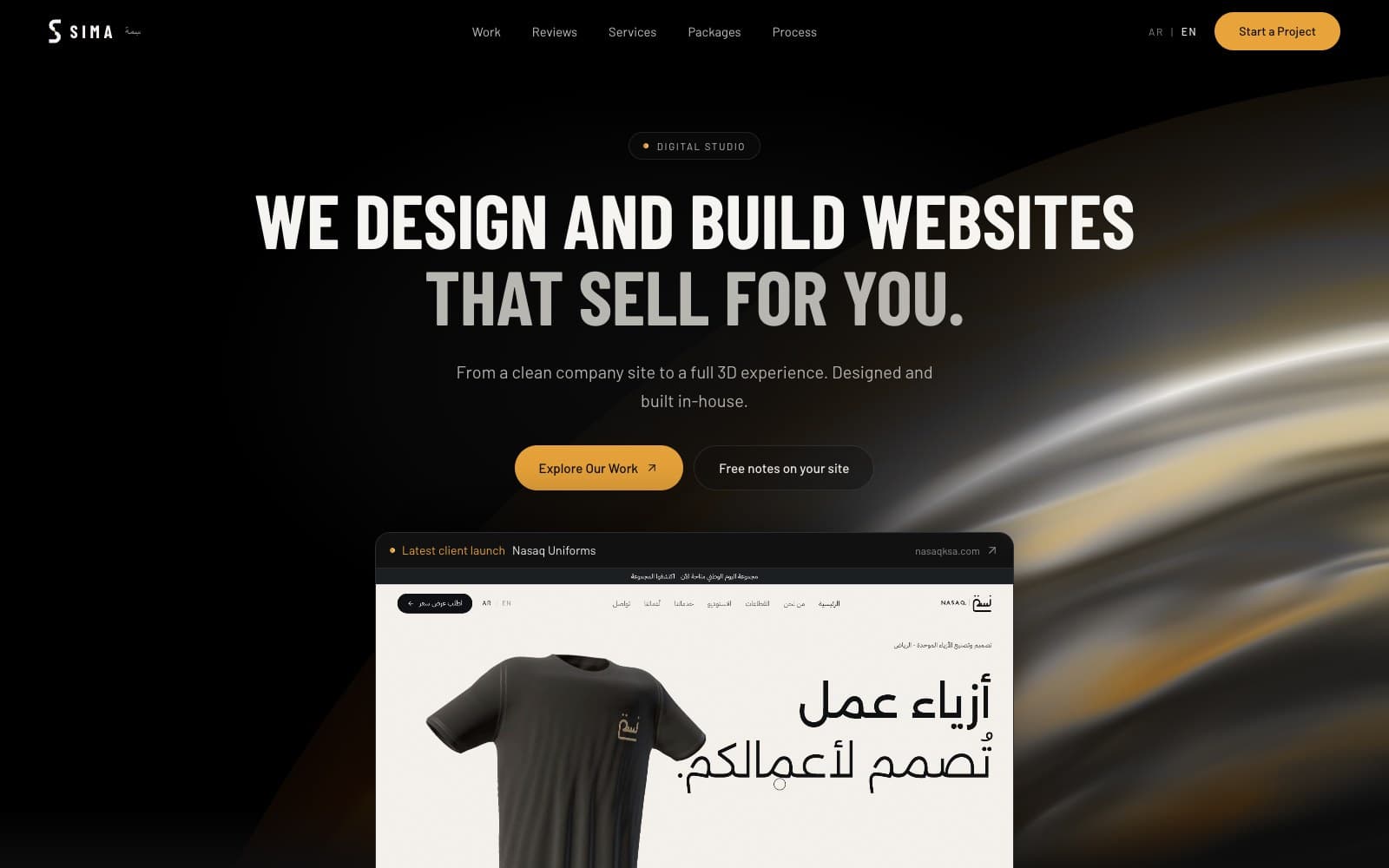
SIMA Studio is my own studio. It designs and builds websites for Saudi companies and brands — Arabic first, with 3D and motion where they earn their place.
The site had to do three jobs at once: show the work, explain what a project costs and how long it takes before anyone has to ask, and turn a visitor into a conversation. It also had to be the studio's own proof: if the work is meant to be premium, the studio's website cannot be the weakest thing in the portfolio.
What I built
The identity. Ink, bone and ash with one saffron accent, a two-part S symbol, Barlow Condensed for display and Alexandria for Arabic. The same system runs from the brand deck through to the favicon.
Arabic as the default. The apex domain lands on /ar; English mirrors it. Every line of copy is written in both languages rather than machine-translated, with type chosen separately for each script and the whole layout designed right to left first.
Case studies, not thumbnails. Each project gets its own page: the brief, the constraint, the idea, the interactions, the stack. Content lives in typed TypeScript files, so a project is data rather than markup, and the index, the case study and the metadata all read from the same source.
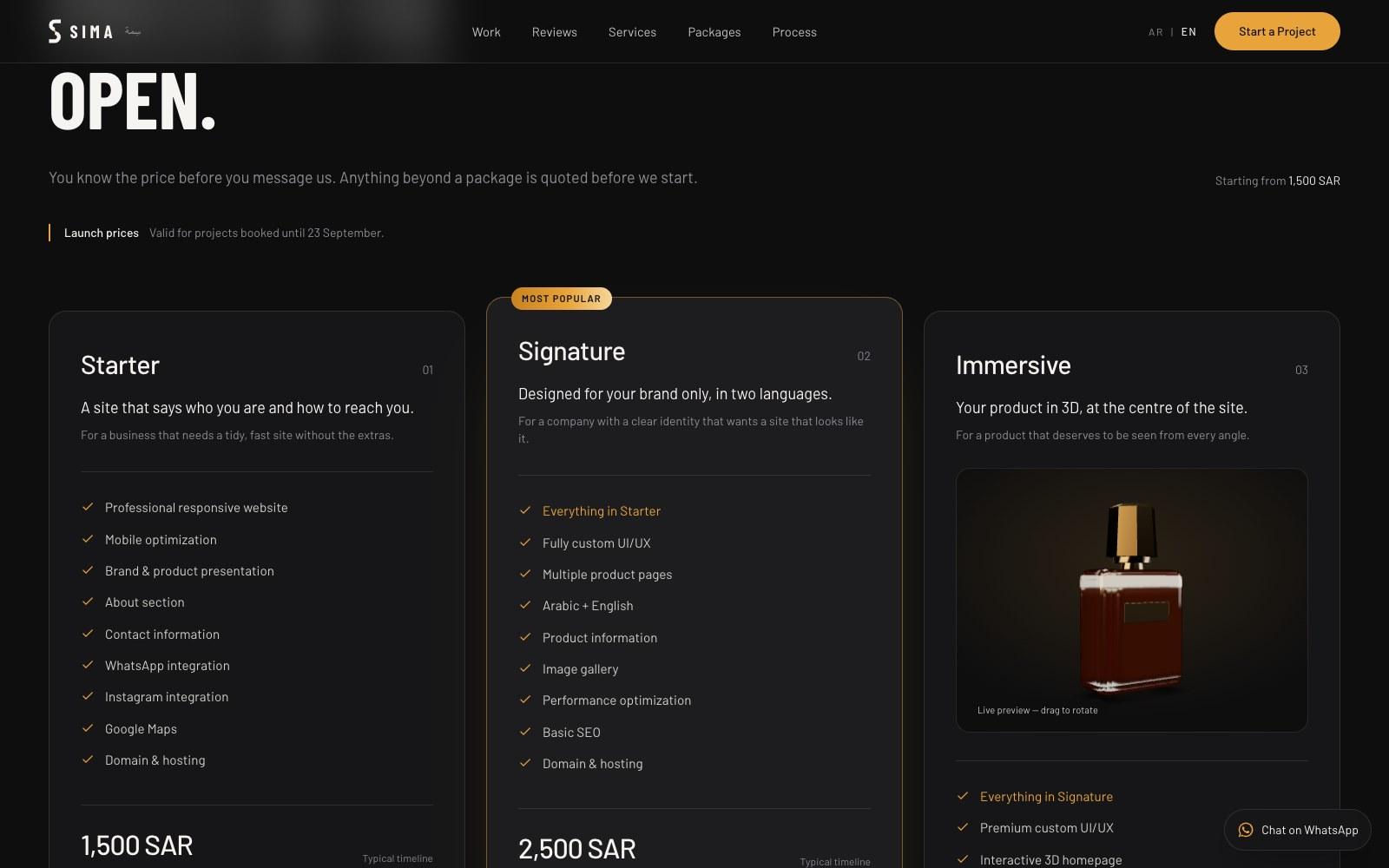
Pricing in the open. Packages, what is and is not included, timelines and the payment split are on the page. That removes the first email exchange from every lead.
Contact and leads. The contact form validates on the server, writes the lead to a Postgres table on Neon and sends the notification through Resend, so nothing depends on an inbox being watched.
Analytics I own. First-party and cookieless: page views, journeys and active sessions stored in my own database and read back in an admin dashboard behind an email-code login, with my own devices excluded so my testing does not pollute the numbers.
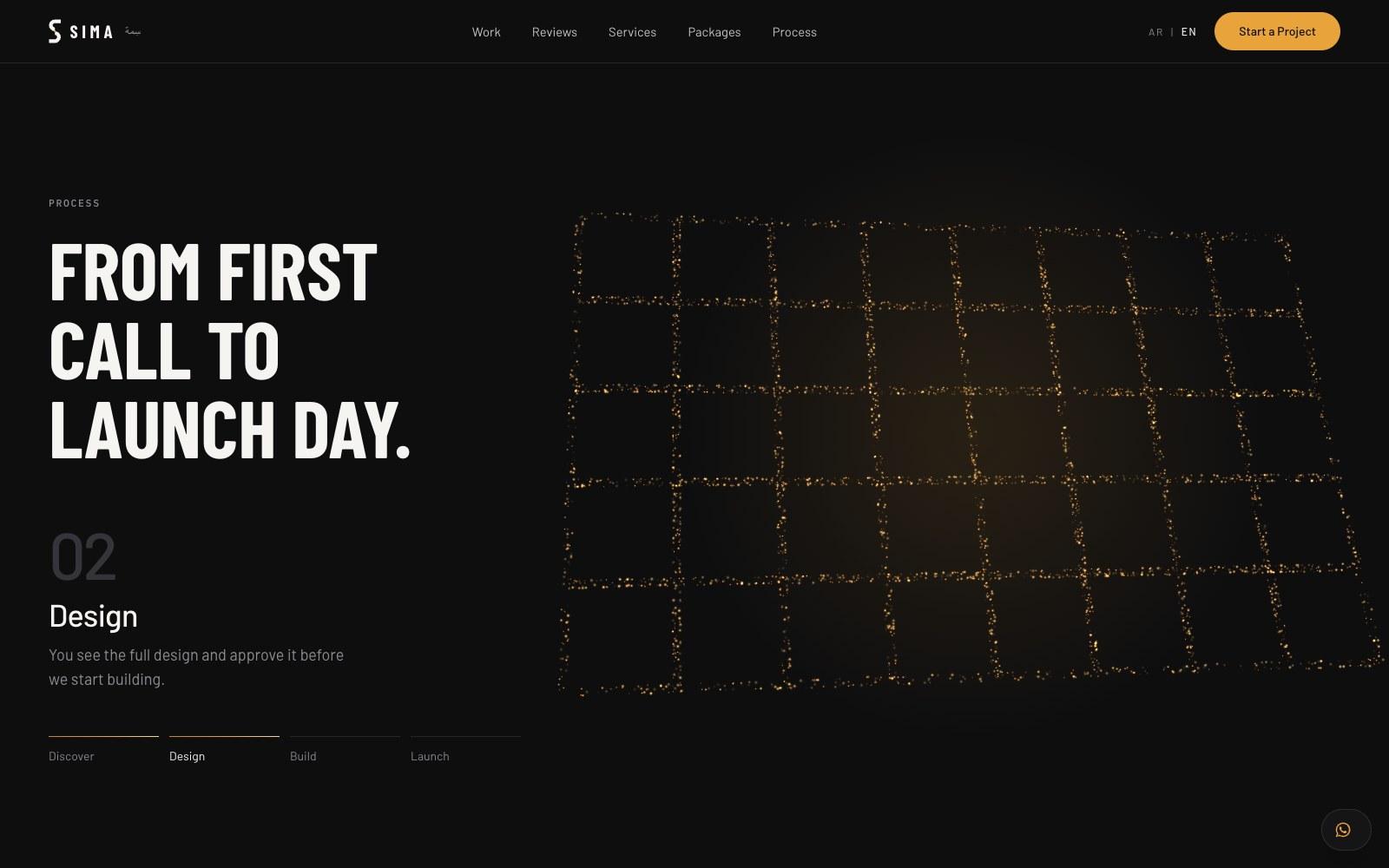
The hero. A spectral light arc rendered in React Three Fiber, kept deliberately light — the 3D is atmosphere, not the pitch.
How it works
The site is a Next.js App Router application on Vercel. There is no separate API service: server components read Postgres directly, and the only route handlers are the ones a browser has to post to — the analytics beacon, the contact form, the review form. The database is Neon Postgres, reached over HTTP with @neondatabase/serverless, which means no connection pool to babysit across serverless instances. Email goes out through Resend.
The data model
Seven tables, all created by an idempotent schema that runs on first use and can also be applied explicitly with npm run db:setup. Trimmed to the shape that matters:
leads.session_id is the join that makes the dashboard useful: a project request can be read next to the pages that visitor saw before they sent it.
Signing in
There are no passwords. The admin allowlist is a constant in the code, so adding an account takes a deploy — the right trade for a two-person studio, and the wrong one for a product, where it would be a users table with roles.
- Email in. The response is identical whether or not the address is on the allowlist, so the form cannot be used to find out who can sign in.
- Rate limits before anything else — ten code requests per IP per hour, three per email per fifteen minutes.
- A six-digit code is generated with crypto.randomInt, stored as an HMAC-SHA256 digest keyed with the server secret, and expires in thirty minutes. The plaintext code exists only in the email.
- Verification compares digests with timingSafeEqual. Five wrong attempts destroy the code. Every attempt — right or wrong — is written to admin_logins with its IP, location and user agent.
- The session is a 32-byte random token; only its SHA-256 is stored. The cookie is __Host- prefixed, httpOnly, secure, SameSite=strict, and lives twelve hours.
- Every request re-validates the session against the database and bumps last_seen, so a session can be revoked — one device, or every device but this one — and the next request is locked out. The login alert email is sent with after(), so it never delays the response.
Two decisions worth naming
Leads are written before they are emailed. The row lands in Postgres first, then Resend is called, then emailed is set. If the mail provider is down, the lead is still on record instead of lost in a failed request.
Rate limiting lives in Postgres, not in memory. Fixed windows keyed by (key, window_start), incremented with insert … on conflict do update … returning count, with a 2% chance per call of sweeping old windows. In-memory counters are free but useless here: every serverless instance would keep its own.
Analytics without cookies
Visitor ids are random per-browser values, hashed with a server secret before storage. The collector rejects bots, validates every field against a pattern and clips it to a maximum length, and keeps only which ad platform a click id came from, never the id itself. My own visits are recorded and flagged rather than dropped — and the flag is sticky per browser, so once a browser is known to be mine, every visit it ever made is excluded from the numbers.
What the dashboard reads back
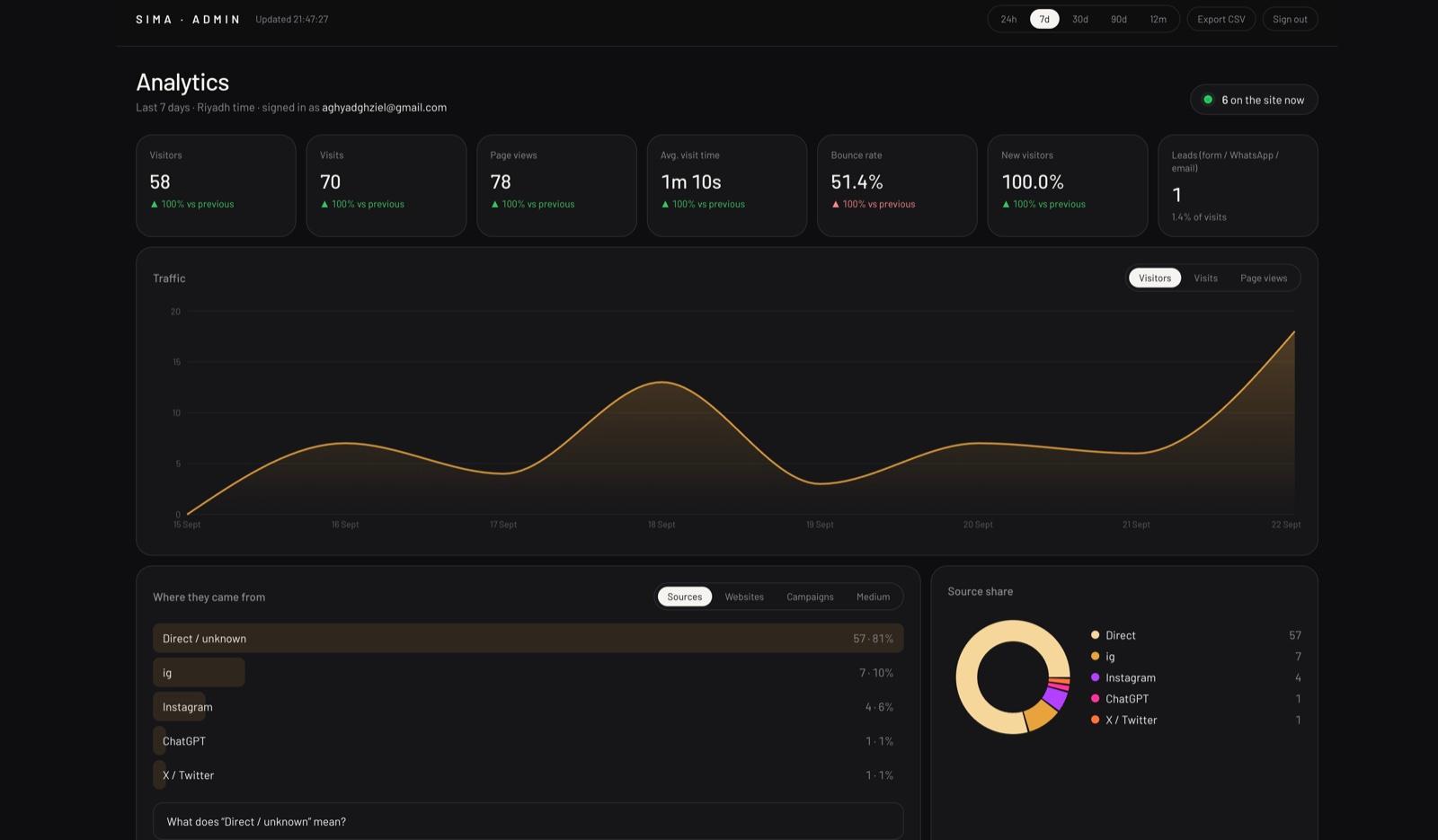
Seven days on my own site, so the numbers are small — that is the honest part. The point is where they come from: every figure on this screen was collected by the beacon, stored in the two analytics tables above, and computed in SQL at request time. No third-party script, no dashboard I rent, no cookie banner, and my own visits excluded before anything is counted. The live count in the corner is sessions whose last_seen is inside the last few minutes.
What I would change at scale
analytics_events grows without bound and would want monthly partitioning and a retention policy. The fixed-window limiter is coarse and would become a sliding window. And the allowlist-as-constant only works while the team is two people.
Notes
The studio's positioning is deliberately narrow: Saudi companies and brands that need Arabic to be the first-class language on their site, not an afterthought. The projects below are what that looks like in practice — one client project, and concepts built to prove the studio can do the work before a client has to take the risk.